

Table of Contents
- Why Zebra Stripes Appear on Driveways
- How to Use a Surface Cleaner Correctly
- The Pressure Washing Overlap Technique That Prevents Lines
- Best Pressure Washer Nozzle for Driveways
- Removing Pressure Washer Marks from Concrete and Block Paving
- Common Mistakes That Cause Striping
- When to Call a Professional
- Frequently Asked Questions
Last Updated: September 11, 2026
Why Zebra Stripes Appear on Driveways
Zebra stripes are the alternating light and dark bands left behind when a pressure washer‘s spray pattern overlaps unevenly across a hard surface. They are the single most common complaint from homeowners who clean their own driveways, and the cause is almost always technique rather than equipment.
The mechanics are simple. A pressure washer nozzle delivers a narrow, high-intensity jet. Where that jet passes, it strips away the top layer of dirt, algae and biological growth. Where it doesn’t, the grime stays. Move the wand in loose, freehand sweeps and you leave a record of every pass: clean strip, dirty strip, clean strip.
Two factors make it worse. First, concrete and block paving are porous, so the “clean” line is etched into the surface rather than sitting on top of it. Second, inconsistent distance and speed mean some areas receive far more cleaning energy than others. The result looks like a zebra crossing painted onto your driveway.
We see this constantly on driveways across the area, and the fix is not more pressure. It is control.
How to Use a Surface Cleaner Correctly
A surface cleaner is the correct tool for flat driveway cleaning because it contains the spray inside a rotating bar under a fixed hood, which removes the freehand variable entirely. Used properly, it delivers an even clean with no banding.
Here is the sequence that works:
- Clear the area and pre-treat organic growth with a suitable cleaner, then let it dwell
- Set the surface cleaner so the skirt sits flat and the bar spins freely
- Work in slow, deliberate passes at a steady walking pace
- Keep the unit level; tilting lifts one edge and leaves a stripe
- Rinse the whole area in one direction at the end to blend the finish
The mistake most people make is rushing. A surface cleaner rewards patience. Move too fast and you get a lighter clean in the centre of the pass, which is just zebra striping in a different costume.
Check your surface cleaner’s bar is actually spinning before you commit to a full pass. A seized or partially blocked bar cleans unevenly and produces exactly the banding you are trying to avoid. A ten-second check saves an hour of rework.
The Pressure Washing Overlap Technique That Prevents Lines
The pressure washing overlap technique is the practice of overlapping each pass by roughly half the width of the cleaning head, so no single edge of the head ever defines a visible line. This is the core discipline behind preventing zebra stripes on driveway cleaning.
Think of it the way you would paint a wall. You do not lay parallel stripes and hope they blend. You overlap so the wet edge always meets a wet edge. A surface cleaner works the same way: each new pass should cover half of the previous pass, keeping the cleaning energy consistent across the whole surface.
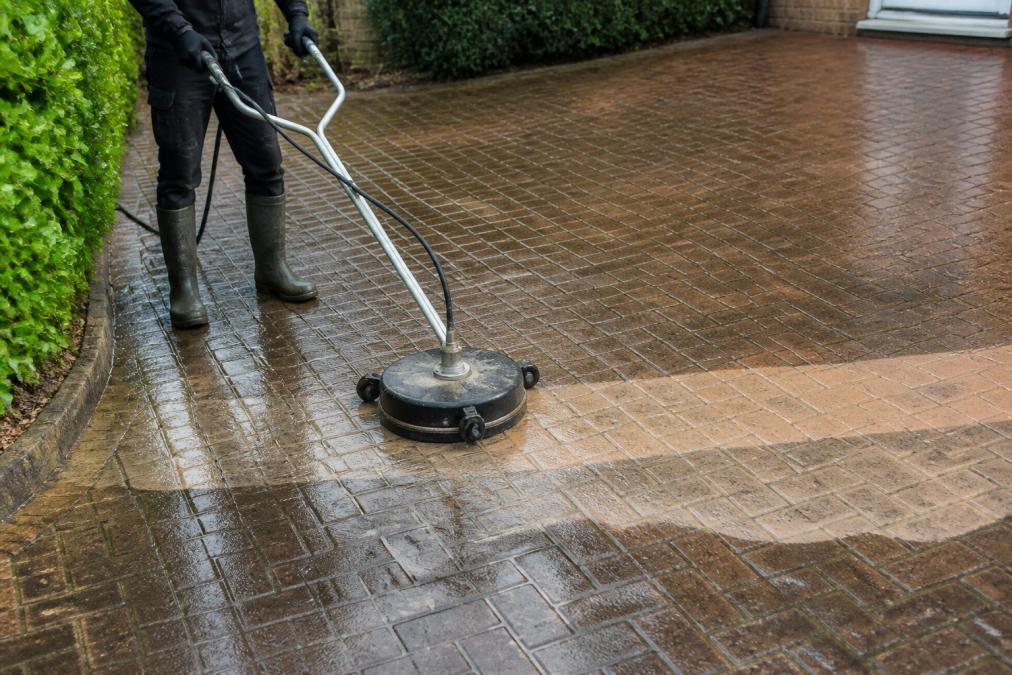
Three rules make the technique reliable:
- Overlap by 50%, not 10%
- Maintain a constant speed across every pass
- Never stop mid-pass with the trigger engaged
That last point matters more than people expect. A stationary surface cleaner burns a circular mark into the surface in seconds. Keep moving, and keep the overlap generous.
Best Pressure Washer Nozzle for Driveways
The best pressure washer nozzle for driveways is a rotary turbo nozzle paired with a surface cleaner, not a fixed fan nozzle used freehand. The turbo nozzle concentrates the jet into a rotating pattern that cleans faster, while the surface cleaner controls where that energy lands.
Nozzle choice comes down to two things: spray angle and intended use.
| Nozzle type | Spray angle | Best for | Risk on driveways |
|---|---|---|---|
| Turbo/rotary | Rotating point jet | Stripping heavy growth | Etching if held still |
| 25-degree | Medium fan | General flat cleaning | Striping if swept freehand |
| 40-degree | Wide fan | Rinsing and delicate surfaces | Underpowered on set-in grime |
| Surface cleaner | Contained rotating bar | Even driveway cleaning | Banding if passes are rushed |
For most driveways, the surface cleaner does the cleaning and a wider nozzle handles the final rinse. A narrow fan nozzle used freehand is the tool most likely to leave you with stripes, so treat it as a rinsing aid rather than your main cleaning head. Matching the nozzle to the surface is a core part of any surface-appropriate cleaning guidance approach.
Removing Pressure Washer Marks from Concrete and Block Paving
Removing pressure washer marks from concrete and block paving is possible, but the method depends on whether the marks are surface dirt or physical etching. Light banding usually lifts with a second, even pass. Deep etching does not reverse.
Start by identifying what you are looking at:
- Lighter stripes are usually uneven cleaning. A slow, fully overlapping pass with a surface cleaner often blends them out.
- Darker stripes are often damp or dirtier bands. These usually respond to a consistent re-clean.
- Physical grooves are etched into the surface. These are permanent and cannot be washed away.
For block paving, the jointing sand is a separate concern. Aggressive pressure strips the sand from the joints, which loosens the blocks and invites weeds (pavingexpert.com). If your paving has been over-washed, re-sanding the joints is part of the repair, not an optional extra.
Never try to fix a stripe by blasting it harder. Increasing pressure on an already-etched area deepens the groove and makes the banding permanent. If a second even pass does not fix it, stop and reassess.
Common Mistakes That Cause Striping
Most striping traces back to a short list of avoidable errors. Fix these and the problem largely disappears.
- Freehand fan-nozzle sweeping. The single biggest cause. Use a surface cleaner on flat surfaces.
- Inconsistent pace. Speeding up in the middle of a pass leaves a lighter band.
- Too much pressure. Higher pressure does not mean a better clean; it means more risk of etching.
- Stopping mid-pass. A stationary head burns a mark in seconds.
- Skipping the pre-treatment. Dirt that should have been loosened chemically gets chased with pressure instead.
- Ignoring the surface type. Concrete, block paving and natural stone all want different handling.
A common mistake is assuming a stronger machine solves the problem. It does not. Control beats power every time, which is why guidance on pressure washing safety and equipment focuses on method rather than brute force.
When to Call a Professional
Calling a professional makes sense when the surface is delicate, the growth is heavy, or the results need to be right first time. Driveways with mature moss and algae, block paving with failing joints, and surfaces being prepared for a property sale all fall into that category.
There is also the risk question. Over-pressure does not just cause stripes; it can drive water into render, gutters and joints, and it can strip protective finishes. Getting it wrong on a surface you cannot easily replace is an expensive lesson.
This is where Aquaclean Solutions fits. We use surface-appropriate methods, we are fully insured, and we handle both domestic and commercial work with reliable booking and clear communication. For homeowners preparing to sell and for property managers who need a consistent finish, that reliability is the point.
If your driveway has visible banding, heavy organic growth, or block paving with failing joints, the cost of a professional clean is usually less than the cost of repairing an over-pressured surface.
Zebra stripes are almost always a technique problem, not a hardware problem, and the fix is control: the right tool, a steady pace, and a generous overlap. When a surface is delicate, heavily soiled, or simply has to look right the first time, professional help removes the risk. Aquaclean Solutions brings surface-appropriate methods, full insurance, and dependable booking to every job, so you get a noticeably cleaner finish without the risk of making things worse. Get a free quote from Aquaclean Solutions and restore your driveway’s natural colour and finish.
Frequently Asked Questions
Why do zebra stripes appear after pressure washing a driveway?
Zebra stripes happen when a pressure washer removes dirt unevenly across a surface. If you move the lance too fast, hold it too close, or fail to overlap each pass, some areas get cleaned more than others. On block paving and concrete, the cleaned strips stand out against the dirtier surrounding surface, creating the striped look. Using a surface cleaner attachment and a consistent overlap technique prevents this by applying even pressure across the full width of the cleaning head.
Does using a surface cleaner prevent zebra stripes?
A rotary surface cleaner dramatically reduces the risk of zebra stripes because it cleans a wide, even path rather than a narrow jet. The spinning bar applies consistent pressure across the full cleaning head, so there are no hard edges between passes. You still need to overlap each pass by around 50% and keep a steady walking pace. If you rush or skip overlaps, faint lines can still appear, especially on heavily soiled block paving.
How do I fix existing zebra stripes on my driveway?
Re-clean the entire driveway using a surface cleaner with a consistent overlap technique. Work in one direction, then repeat at 90 degrees to blend the passes. If the stripes persist, apply a dedicated patio or driveway cleaner, leave it to dwell for the recommended time, then rinse evenly. For block paving, re-sanding the joints after cleaning helps restore a uniform appearance. Severely etched concrete may need professional attention.
Is it better to use a fan nozzle or a rotary nozzle for driveways?
A rotary nozzle, usually part of a surface cleaner attachment, is the better choice for driveways. It spreads pressure across a wide circular path and cleans evenly, which is exactly what prevents zebra stripes. A fan nozzle concentrates pressure into a narrow strip, making it easy to leave visible lines. Use a fan nozzle only for edges, steps and tight corners where a surface cleaner cannot reach, and keep the pressure low in those areas.